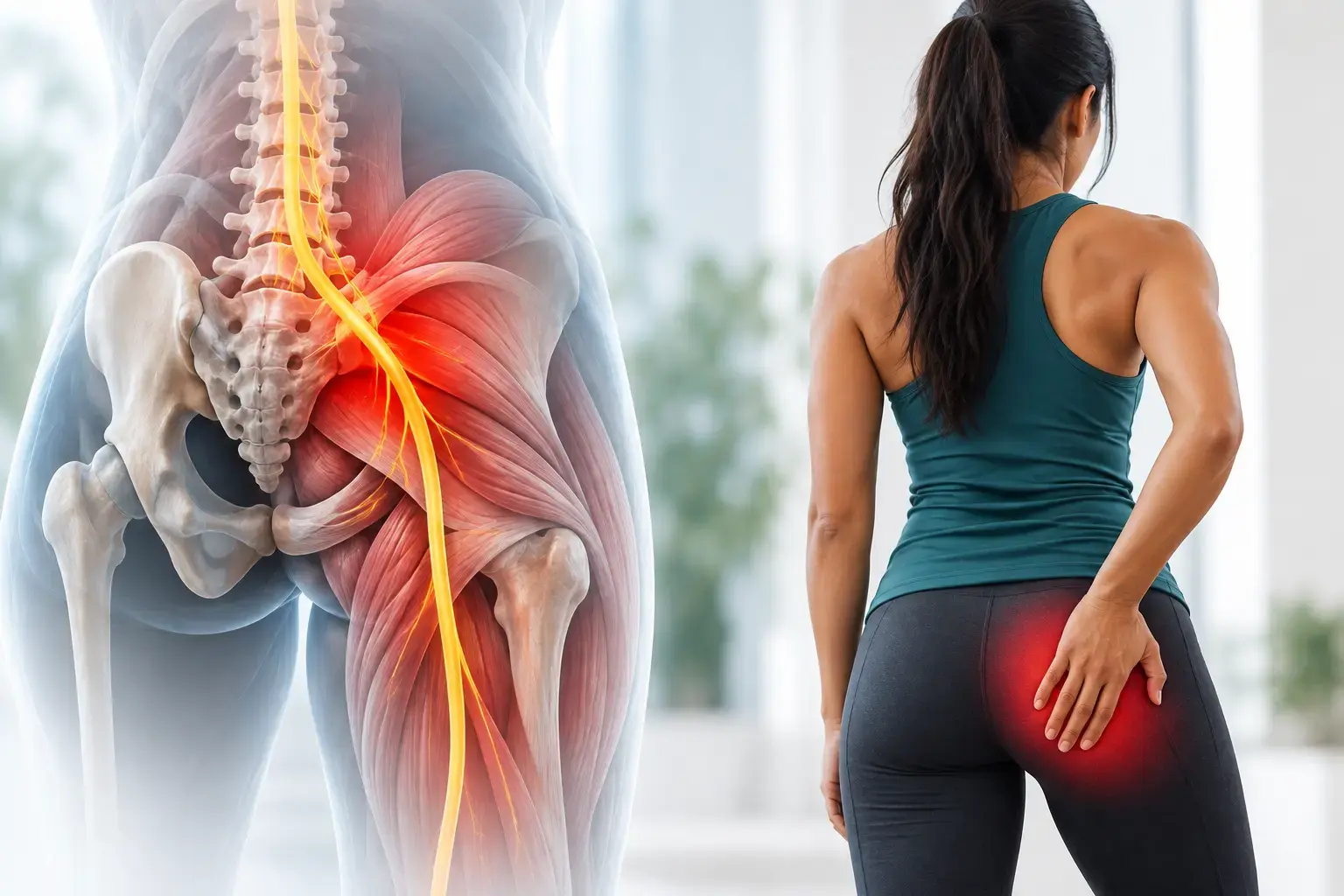
Understanding Deep Gluteal Syndrome, Sciatic-Type Pain and Treatment
Pain deep in the buttock can be frustrating, particularly when it interferes with sitting, walking, driving or exercise.
Sometimes the discomfort remains around the buttock. In other cases, symptoms may extend into the back of the thigh, occasionally accompanied by tingling or altered sensation.
A common explanation is piriformis syndrome, often accompanied by the suggestion that the piriformis muscle is tight and needs stretching.
But is the piriformis necessarily responsible?
Not always.
The deep gluteal region contains several muscles, tendons and nerves, and symptoms arising from this area can have different explanations. Understanding these differences is important when deciding how best to manage the problem.
What Is Deep Gluteal Syndrome?
Deep Gluteal Syndrome (DGS) describes a group of presentations involving irritation or entrapment of the sciatic nerve within the deep gluteal space, rather than at the nerve roots in the lower back.
The sciatic nerve is the largest nerve in the body. It travels from the lower spine through the pelvis and buttock before continuing down the back of the leg.
As it passes through the deep gluteal region, it lies close to several muscles and other anatomical structures.
Historically, symptoms associated with this area were often labelled piriformis syndrome, based on the possibility of irritation or compression of the sciatic nerve by the piriformis muscle.
However, the piriformis is only one of several structures that may be involved. The broader term Deep Gluteal Syndrome recognises this anatomical complexity.
Importantly, not all deep buttock pain represents sciatic nerve entrapment, and distinguishing between potential sources of symptoms is an important part of clinical assessment.
Understanding the Anatomy
The deep gluteal space lies beneath the gluteus maximus, the large muscle forming much of the buttock.
Several structures occupy this region, including:
- Piriformis
- Superior and inferior gemelli
- Obturator internus
- Quadratus femoris
- Proximal hamstring tendons
- Sciatic nerve
The sciatic nerve moves in relation to surrounding tissues as the hip changes position.
Under certain circumstances, irritation or restriction of the nerve may occur within this region.
However, identifying the precise source of symptoms isn’t always straightforward. The presence of pain around a particular muscle doesn’t necessarily mean that muscle is responsible.
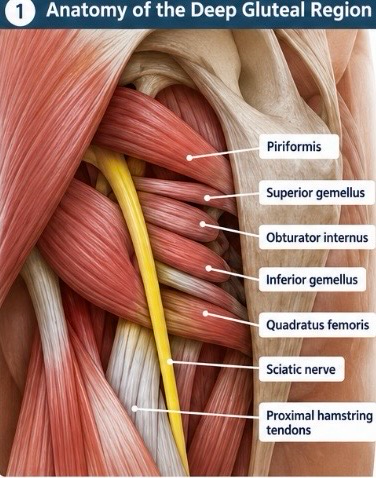
The sciatic nerve passes through an anatomically complex region containing several muscles, tendons and other structures.
What Causes Deep Gluteal Syndrome?
There isn’t one single cause.
Reported mechanisms of sciatic nerve irritation or entrapment include involvement of the piriformis, fibrous bands, the obturator internus/gemelli complex and structures around the proximal hamstring region.
Previous injury, surgery or associated scar tissue may occasionally contribute. Other structural conditions around the posterior hip can also produce overlapping symptoms.
More recent research has questioned whether all presentations of deep gluteal pain can be explained solely by nerve entrapment, with muscle and tendon-related conditions potentially contributing to some cases.
This is an evolving area of clinical research, and there are still limitations in our understanding of the underlying mechanisms.
It is also worth distinguishing between activities that aggravate symptoms and factors that actually cause a condition.
For example, someone may notice buttock pain during prolonged sitting or running. That doesn’t automatically establish that sitting or running caused sciatic nerve entrapment.
Similarly, having weak gluteal muscles or reduced flexibility doesn’t, by itself, establish a diagnosis.
What Does Deep Gluteal Syndrome Feel Like?
Symptoms can vary considerably, but commonly reported features include:
- Deep buttock or posterior hip pain
- Discomfort extending into the back of the thigh
- Tingling, altered sensation or sciatic-type symptoms
- Pain aggravated by prolonged sitting
- Symptoms associated with certain hip positions or activities
Some people primarily experience localised buttock pain, while others describe symptoms that resemble sciatica.
These features may raise suspicion of DGS, but symptoms alone cannot reliably confirm the diagnosis.
Other conditions affecting the lumbar spine, hip or surrounding tendons can produce similar presentations.
Could Your Buttock Pain Actually Be Coming From Your Back?
This is an important consideration.
Sciatica is commonly associated with irritation or compression of a nerve root in the lumbar spine.
Depending on the nerve involved, symptoms may include pain, tingling, altered sensation or weakness extending into the buttock and leg.
Deep Gluteal Syndrome describes a different potential location of nerve involvement, further along the sciatic nerve’s course.
Despite these anatomical differences, the symptoms can overlap.
Someone experiencing buttock and posterior thigh pain may therefore require assessment of the lumbar spine, hip and neurological system alongside the deep gluteal region.
The location of pain doesn’t always identify its source.
This is one reason why treating every episode of buttock pain as piriformis syndrome can be misleading.
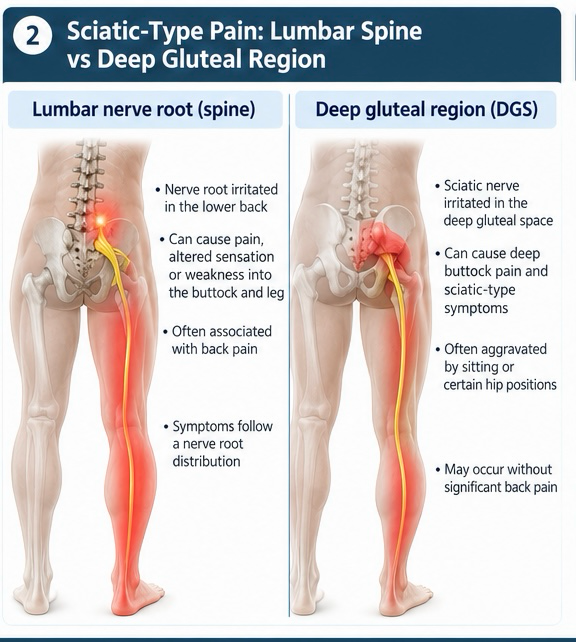
Similar symptoms may arise from different locations along the nervous system. Clinical assessment helps distinguish between potential sources.
How Is Deep Gluteal Syndrome Diagnosed?
There isn’t one definitive test that establishes the diagnosis in every patient.
Assessment begins with understanding the history and behaviour of symptoms.
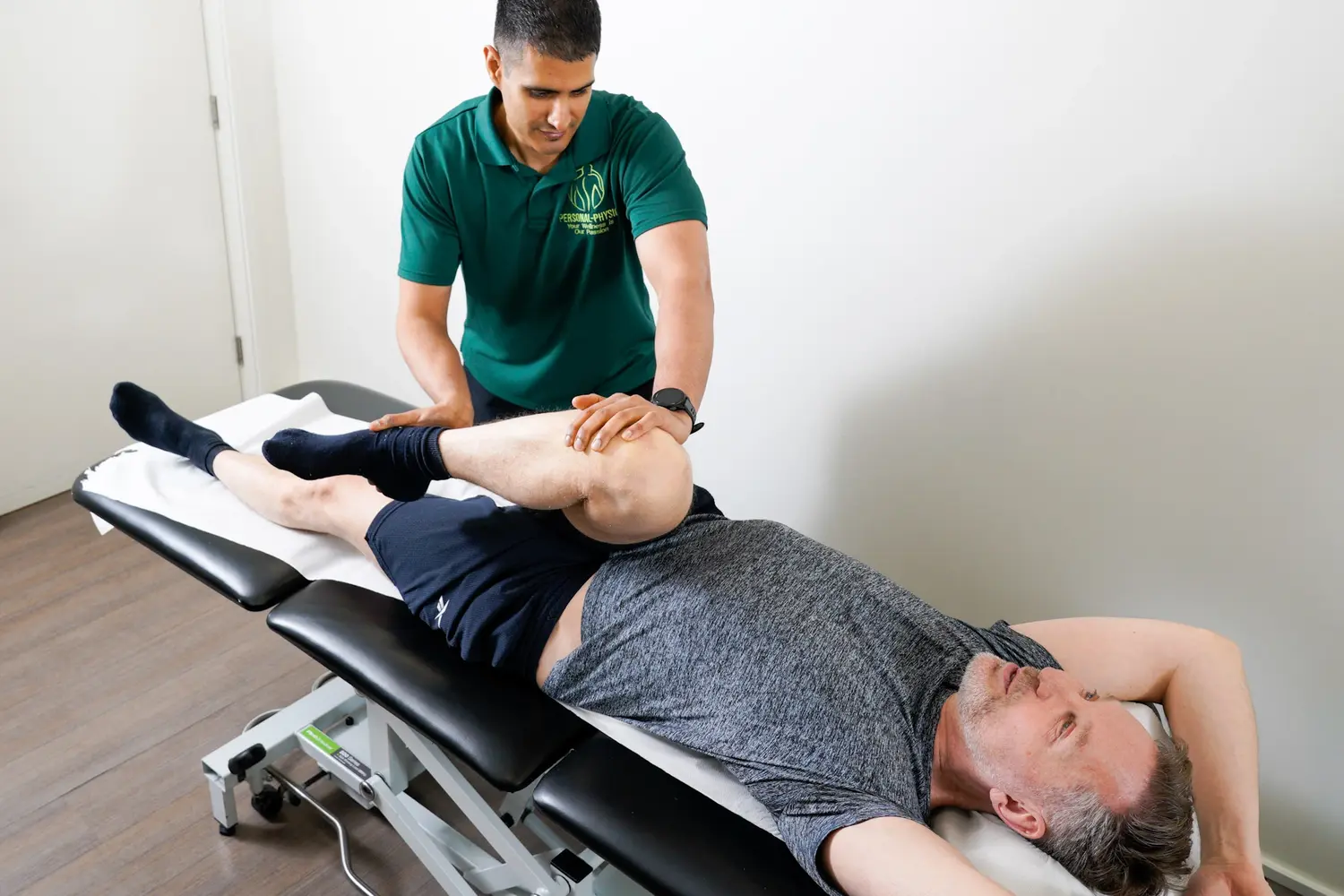
A physiotherapist may explore when the symptoms began, which activities aggravate or relieve them, whether there are neurological symptoms and how the problem affects daily activities.
The physical examination may then include assessment of:
- Lumbar spine movement and symptom response
- Hip mobility and function
- Neurological signs, including strength and sensation
- Local tenderness and symptom reproduction
- Specific clinical tests for potential sciatic nerve involvement
Research has examined tests such as the active piriformis test and seated piriformis stretch test. Although these may provide useful information, their findings need to be interpreted alongside the wider clinical picture.
In some circumstances, imaging or specialist investigation may be appropriate, particularly when symptoms are persistent, atypical or not responding as expected.
The objective is to develop a clinically reasoned understanding of the presentation rather than relying on one test or assuming that pain in a particular location identifies the diagnosis.
Should You Stretch Your Piriformis?
Stretching is one of the most frequently recommended approaches for buttock pain.
It may provide symptom relief for some people, but there is a problem with the assumption that buttock pain necessarily indicates a tight piriformis.
Pain doesn’t automatically mean a muscle is shortened, and a tight-feeling muscle isn’t necessarily the source of the problem.
Even when the piriformis is involved, repeatedly stretching it may not address the factors contributing to symptoms.
For some people, particular hip positions or stretching movements may actually aggravate their discomfort.
This doesn’t mean stretching should always be avoided. It means the decision to use it should be guided by the individual’s presentation and response.
Rather than asking, “What’s the best piriformis stretch?”, a more useful question may be:
“What is contributing to my symptoms, and what approach is most appropriate for my situation?”
What Does the Research Say About Treatment?
Research into the treatment of Deep Gluteal Syndrome remains relatively limited.
A systematic review of conservative and surgical treatments included 13 studies involving 508 patients. The authors identified limitations in the overall quality of evidence and concluded that no individual conservative treatment could be recommended over another.
Conservative management, including physiotherapy, is generally considered an appropriate starting point.
Depending on the presentation, treatment may involve education, symptom management, modification of aggravating activities and progressive rehabilitation.
Hands-on treatment may sometimes be used to help manage symptoms alongside rehabilitation. Acupuncture may also be considered as an adjunct in selected cases, although evidence specifically supporting its effectiveness for DGS remains limited.
For persistent presentations, specialist assessment and treatments such as image-guided injections may be considered. Surgery is generally reserved for selected cases involving suspected or identified nerve entrapment that has not responded adequately to conservative management.
There is currently no single treatment approach proven to be optimal for everyone with Deep Gluteal Syndrome.
This reinforces the importance of matching treatment to the individual rather than applying the same approach to every person with buttock pain.
How Can Physiotherapy Help?
Physiotherapy can be useful when buttock pain is persistent, recurrent or interfering with normal activities, particularly when the underlying source of symptoms is unclear.
The initial priority is to understand the presentation.
That may involve distinguishing between symptoms arising from the lumbar spine, deep gluteal region, hip or surrounding structures, while identifying any signs that warrant further investigation.
From there, management can be tailored to the person’s symptoms, physical examination and goals.
For example, someone struggling with prolonged sitting may have different priorities from a runner whose symptoms appear during training.
Rehabilitation may involve restoring comfortable movement, developing strength and physical tolerance, and gradually returning to activities that have become difficult.
Progress can then be reviewed and adjusted according to how the person responds.
The value of physiotherapy lies not simply in providing exercises, but in clinical assessment, appropriate treatment selection and guiding rehabilitation as symptoms and functional demands change.
When Should You Seek Professional Advice?
An assessment may be worthwhile if buttock pain:
- Persists or repeatedly returns
- Interferes with sitting, walking, work or exercise
- Is associated with tingling, numbness or radiating leg symptoms
- Is becoming progressively more limiting
- Has not improved as expected with initial self-management
New or progressive leg weakness requires prompt medical assessment. New bladder or bowel dysfunction, saddle numbness or other symptoms suggestive of cauda equina syndrome require emergency medical assessment.
So, Is It Really Piriformis Syndrome?
Sometimes the piriformis may be involved, but it shouldn’t automatically be blamed whenever someone develops deep buttock pain.
The lumbar spine, hip, sciatic nerve and surrounding muscles and tendons can all contribute to symptoms in this region.
Understanding the likely source of symptoms is therefore more useful than assuming one muscle is responsible and repeatedly trying to stretch it.
An accurate assessment helps guide appropriate management, particularly when symptoms are persistent or limiting your normal activities.
Struggling With Persistent Buttock or Sciatic-Type Pain?
At Personal-Physio, we provide physiotherapy assessment and individualised rehabilitation to help you better understand your symptoms and work towards returning to the activities that matter to you.
Appointments are available in Soho, Central London, with home visits also available across London.
Arrange a Physiotherapy Appointment
Assess. Treat. Rebuild. Perform.
Move Better. Get Stronger. Stay Capable.
References
- Kizaki K, Uchida S, Shanmugaraj A, et al. Deep gluteal syndrome is defined as a non-discogenic sciatic nerve disorder with entrapment in the deep gluteal space: a systematic review. Knee Surgery, Sports Traumatology, Arthroscopy. 2020;28:3354–3364. PubMed
- Martin HD, Reddy M, Gómez-Hoyos J. Deep gluteal syndrome. Journal of Hip Preservation Surgery. 2015;2(2):99–107. PubMed
- Martin HD, Kivlan BR, Palmer IJ, Martin RL. Diagnostic accuracy of clinical tests for sciatic nerve entrapment in the gluteal region. Knee Surgery, Sports Traumatology, Arthroscopy. 2014;22:882–888. PubMed
- Hopayian K, Mirzaei M, Shamsi MB, Arab-Zozani M. A systematic review of conservative and surgical treatments for deep gluteal syndrome. Journal of Bodywork and Movement Therapies. 2023;36:244–250. PubMed
- Geler Külcü D. Deep gluteal syndrome: An underestimated cause of posterior hip pain. Turkish Journal of Physical Medicine and Rehabilitation. 2024;70(1):4–16. Full text
- Yoon YH, et al. Beyond Nerve Entrapment: A Narrative Review of Muscle–Tendon Pathologies in Deep Gluteal Syndrome. Diagnostics. 2025;15(19):2531. Full text